
I build Skoot CRM. It automates DMs and follow-ups for Skool communities. A big part of what it does is help owners reduce churn.
But I also run a Skool community myself. So I deal with churn too. Here's what actually worked for me.
Think of it like a leaky bucket

New members come in the top. Churned members leak out the bottom. If more leave than join, your revenue drops.
For a long time I was focused on getting more members in. I should have been plugging the holes first.
The Skool data you should know
Skool has millions of members across the platform. The data shows something important:
- Months 1-3 are the highest churn months. ~20% is normal.
- After 90 days, churn drops to ~10%.
- After 6 months, churn drops to ~2%.
~20%
average churn months 1-3
~2%
average churn after 6 months
This means two things:
- If your group is less than 90 days old, don't panic. Your churn numbers are inflated because no one has reached the low-churn zone yet.
- Your job is to get members past 90 days. Anything that helps them stick through the first 3 months is high leverage.
I asked people why they left
When someone canceled, I sent them a short DM: "Hey, what made you leave?"
A lot of people ghosted me. But some gave real feedback. And those responses gave me everything I needed to improve.
I automated it so every single canceled member gets asked. 100% consistent.
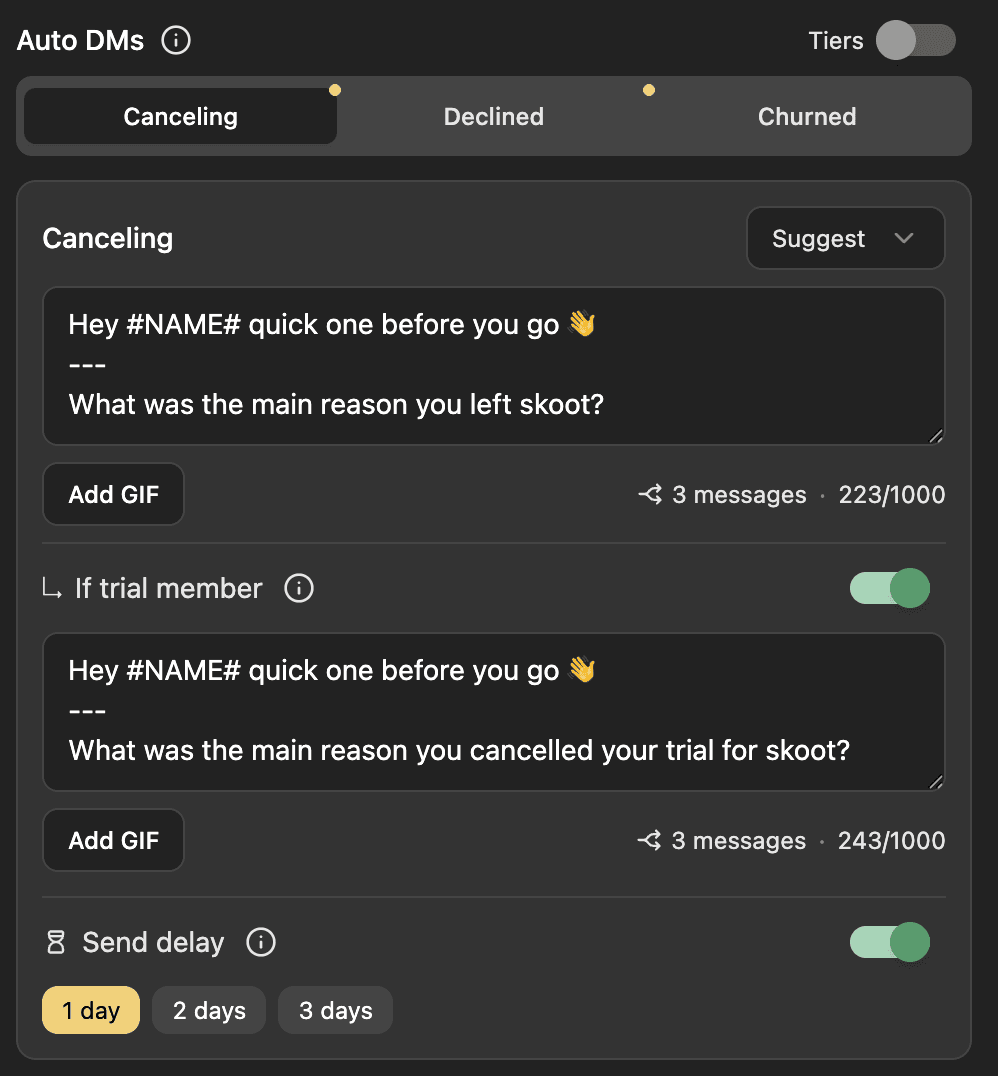
Now when someone cancels or their card declines, they get a message automatically. There's a separate one for trial members too. Runs in the background without me thinking about it.
I also built a free tool that reads your last 30 churn conversations and gives you a ranked list of why people left.
I built everything from feedback
Almost every feature in Skoot came from member feedback. When someone told me what was wrong, I fixed it. When multiple people told me the same thing, I fixed it faster.
But one change had the biggest impact on churn by far.
24/7 automations
Skoot used to only run automations while your browser extension was open. That meant if your computer was off, nothing ran. No auto-DMs. No follow-ups. Nothing.
Members were slipping through the cracks overnight, on weekends, whenever someone closed their laptop. The system only worked when you were at your desk.
So I rebuilt it. Now all automations run 24/7 on our servers. Your computer can be off. You can be asleep. The DMs still go out. The follow-ups still happen.
This was the single biggest thing I did to help our users reduce churn. When the automations never stop, members don't fall through the cracks.
What else helps
These come from Sam Ovens' breakdown on reducing churn, where he shares patterns from across the Skool platform. Same video where the ~20% month 1 and ~2% month 6 stats come from.
If price is the issue, add a lower tier. Some owners heard "too expensive" over and over. When they added a cheaper option, retention jumped.
If members feel overwhelmed, delete stuff. One community owner had 30% churn. He deleted the content nobody used. Churn dropped to 5%.
Add an annual option. Members who pay yearly churn way less. Standard discount is ~17%. If monthly is $10, annual is $100.
Show up every day. When the owner is active, members stay. When the owner disappears, members leave.
Get members to the value fast. If your best content is buried in week 4, move it to day 1. Pin it. Send an auto-DM about it.
It works
Rose Brisby runs Rose Credit Academy on Skool. Before she automated her churn messages, her community manager was manually DMing every canceled member.
After setting up auto-DMs, her churn dropped 3-4%.
Rose Credit Academy
“
Before I found Skoot, I was having my community manager DM all of our students individually when their cards declined or they cancelled. That alone dropped my churn rate by about 3 to 4%. They keep dropping new features that are helping me further automate my Skool community so we don't have to do so much manual work.
Rose Brisby
Community Owner
The short version
- Don't panic early. Month 1 churn is always high. It drops over time.
- Ask why people leave. One DM. One question. Automate it so you don't forget.
- Build from feedback. The members who leave will tell you exactly what to fix.
- Make your automations run 24/7. Members don't churn on a schedule. Your follow-ups shouldn't either.
- Show up every day. When you care, members care.